20231002173920.jpg)

A rare work by Joan Miró at auction: a hand-enhanced lithograph
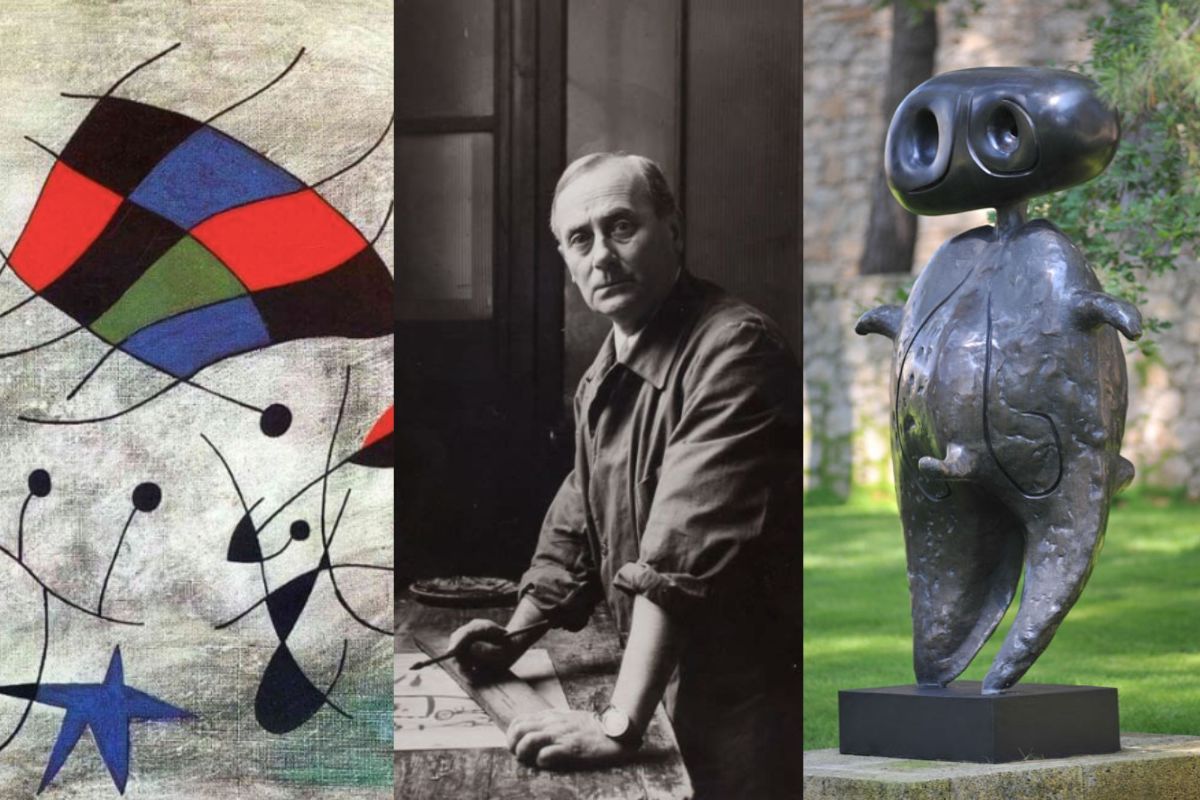
Born in Barcelona in 1893 and passing away in Palma de Mallorca in 1983, Joan Miró stands as a central figure of European modernity. Painter, sculptor, ceramicist, and printmaker, he developed a visual language of unparalleled freedom and poetry. His work unfolds as an autonomous universe of signs, constellations, and inner rhythms, where color and line become living forces. Miró declared that he wished to “kill painting to recreate it”¹—an arresting formula that captures his quest to transcend artistic boundaries and to ceaselessly renew the means of expression.
His art inhabits a space between dream and reality, abstraction and figuration, silence and chromatic explosion. Biomorphic forms, celestial bodies, and primal marks compose a visual language that the artist himself described as “painted poetry.” Miró does not seek to represent the world, but to recreate it through sign and gesture—an act driven by vital, spontaneous energy. Though close to the Surrealists, he never allowed himself to be confined by their automatism, instead forging an aesthetic of apparent simplicity, where each line bears the weight of an entire universe.
The printed work: A laboratory of gesture
From the 1930s onward, Miró immersed himself in the arts of etching and lithography. For him, printmaking was not a secondary or reproductive art, but a laboratory of visual experimentation. Through his collaborations with the Mourlot workshops in Paris and Polígrafa in Barcelona, he discovered the experimental richness of metal and stone—the resistance of the medium, the surprise of the final print. These technical constraints became catalysts for invention.
As Jacques Dupin observed in his seminal work Miró Engraver², the artist “finds in printmaking the very place where his imagination is sharpened, where his visual language is freed from all rational control.” Miró’s printed œuvre, catalogued in several volumes, now forms one of the major corpuses of modern printmaking—playful, liberated, and profoundly poetic.
Hand-enhanced prints: The return of the artist’s touch
Within this vast body of work, a particular group of prints stands apart for its uniqueness: the hand-enhanced impressions. In these rare pieces, Miró intervenes directly on the printed surface—with ink, gouache, or pastel—endowing each impression with absolute individuality. These interventions disrupt the mechanical reproducibility of printmaking and restore the presence of the artist’s hand, the vibration of the painter.
Miró once confessed: “I am always searching for the freshness of the first stroke—the moment when the hand rediscovers the world’s self-evidence.”³ This immediate rapport with matter makes these hand-enhanced prints a direct extension of his painting, while also providing a field for improvisation where sign and form are perpetually reinvented. Each impression becomes a self-contained creation, poised between the original artwork and the printed series, in a fertile tension between technical constraint and poetic freedom.
Les Essències de la Terra, 1968
The work presented in this sale, Les Essències de la Terra (The Essences of the Earth), created in 1968, fully embodies this creative dynamic. Printed in color lithography at the Mourlot workshops and published by Polígrafa in Barcelona, it is hand-enhanced in India ink on Japan paper. This delicate support, with its silky texture and subtle transparency, magnifies the luminosity of the inks and the fluidity of the line. Each enhancement emphasizes a motif, reinforces a rhythm, amplifies a chromatic vibration—the artist’s hand conversing with the printed surface to recreate the miracle of spontaneity.
In this mature work, Miró condenses his entire visual philosophy. Earth, matter, and the primal elements become language. Color patches and signs float within a purified space governed by an inner rhythm. Les Essències de la Terra—literally The Essences of the Earth—evokes a return to origins: the origins of the world, and of the artist’s gesture. Its elemental title encapsulates the bond between nature and spirit, between vital energy and poetic breath.
The work belongs to a particularly fertile period, at the turn of the 1960s and 1970s, when Miró—at the height of his international recognition—returned to the vigor of the line and the spontaneity of the sign. It perfectly illustrates the constant dialogue between control and impulse, rigor and improvisation, that defines his entire graphic oeuvre.
|

Les Essències de la Terra embodies that rare moment when lithography—traditionally regarded as the art of multiples—becomes the site of a unique gesture. Through his hand-enhancement, Miró restores the sensual dimension of creation, transforming each impression into a fully original work. This lithograph, at once vibrant and meditative, encapsulates Miró’s very spirit: a tension between the lightness of the sign and the density of the world, between the artist’s hand and the breath of the earth.
¹ Interview with Georges Raillard, Miró parle, Gallimard, 1977.
² Jacques Dupin and Ariane Lelong-Mainaud, Miró Graveur, vols. I–IV, Maeght Éditeur, Paris, 1972–1982.
³ Quoted in Roland Penrose, Miró, Thames & Hudson, London, 1970.
Auction date: Saturday, November 8 – 2:00 PM
The sale will take place at our auction house and will be streamed live.
Preview exhibition: Tuesday, November 4 – Saturday, November 8.
Consult the catalogue via the following link.