
20231002173920.jpg)

A Lalanne lamp takes flight in Saint-Paul de Vence
François-Xavier Lalanne: Between sculpture and the Art of living
“I create sculptures that can be used, but I do not make design.”¹ This quote by François-Xavier Lalanne perfectly captures the spirit of his work: erasing the boundary between functional object and sculpture, between everyday life and museum art.
Born in Agen in 1927 and passing away in 2008, François-Xavier Lalanne grew up in an intellectual and artistically minded environment. After studying drawing and sculpture, he settled in Paris, where he met Claude Dupeux, later Claude Lalanne, who would become both his wife and artistic collaborator. Together, they formed one of the most emblematic artistic couples of the 20th century. They created a world instantly recognizable, where nature, animals, and vegetation became the protagonists of a unique sculptural language².
From an early stage, François-Xavier Lalanne developed a fascination for the animal kingdom. Monkeys, rhinoceroses, sheep, hippopotamuses, ostriches, and birds populate his work with an apparent simplicity that conceals a profound reflection on form and function. His bestiary was never purely decorative: it became furniture, intimate architecture, and inhabitable sculpture. His famous Wool Sheep, his Rhinocrétaires, and his sculptural bars helped establish his work in some of the world’s most important private and museum collections.
Close to figures such as Yves Saint Laurent and Pierre Bergé, Lalanne belongs to a discreetly Surrealist lineage. He transformed reality with elegance, without unnecessary provocation, preferring quiet humor to spectacular effect. His work rests on a simple yet rare idea: making the ordinary extraordinary³.
This reversal of perspective recalls another of his convictions: “Why couldn’t a sheep be an armchair?”⁴ This almost childlike question contains his entire artistic philosophy. Why shouldn’t an animal become furniture? Why should art remain separate from use? Why couldn’t beauty inhabit everyday life? At the crossroads of sculpture, design, and decorative arts, François-Xavier Lalanne built a body of work that is immediately recognizable—both accessible and deeply sophisticated—which continues to captivate major international collectors today.
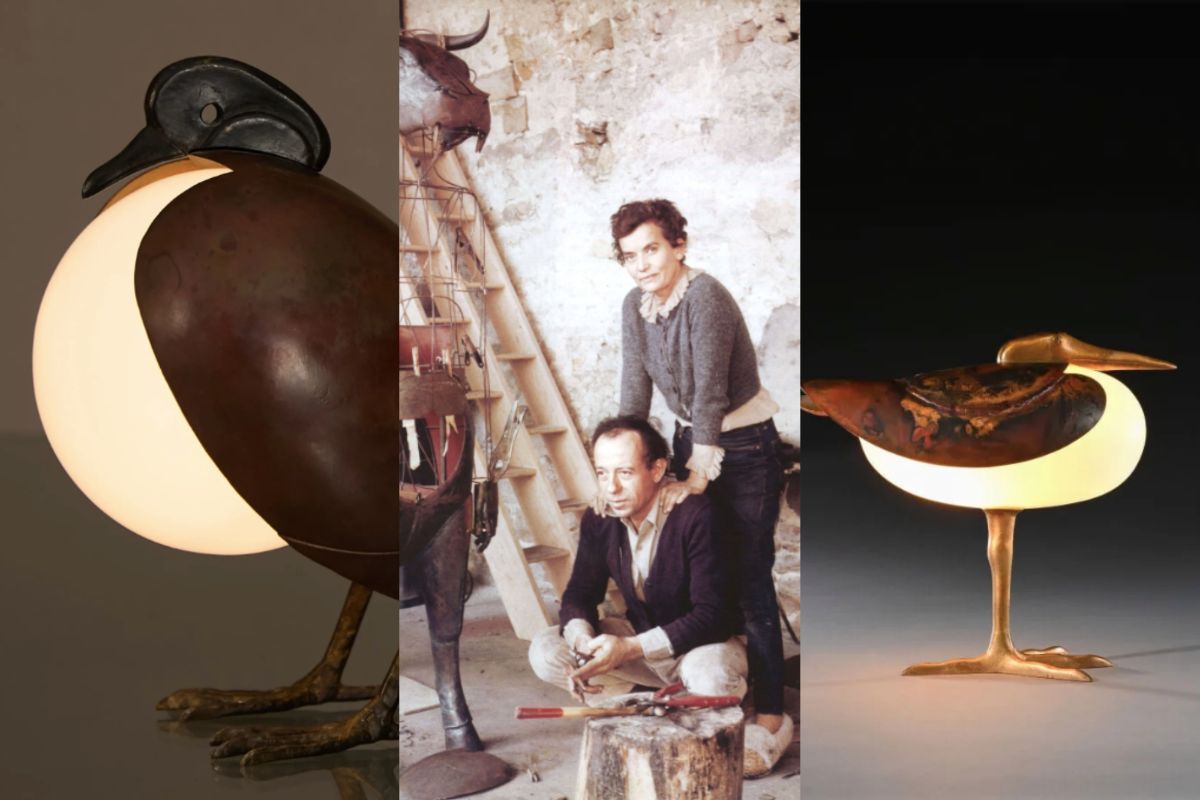
The “Pigeon” table lamp: The poetry of everyday life
It is within this spirit that the “Pigeon” table lamp emerged in the 1990s, an emblematic work of Lalanne’s desire to bring sculpture and domestic function into dialogue.
At first glance, the choice of subject is surprising. The pigeon is one of the most familiar animals in urban life—often ignored, sometimes despised, rarely celebrated. Yet François-Xavier Lalanne chose to turn it into a precious, almost noble object. He elevates an ordinary bird to the status of domestic sculpture, in a gesture that is both poetic and playful⁵.
Made of patinated copper, the lamp takes on a stylized yet instantly recognizable silhouette. The bird’s body forms the base, while the light source is discreetly integrated into the structure, as though the light naturally emanated from the animal itself. Nothing is ostentatious: the lighting does not disrupt the sculpture, but simply extends its presence. This unity between form and function is one of Lalanne’s most distinctive signatures⁶.
This subtlety is essential. For Lalanne, function must never overpower the poetry of the object. The “Pigeon” lamp is not a lamp decorated with a pigeon; it is a pigeon that has become a lamp, with all the ambiguity and magic that implies.
The very choice of the pigeon is particularly revealing. An omnipresent animal, yet rarely celebrated in art history, it becomes here a subject worthy of contemplation. This reversal of status reflects the artist’s discreet humor and his taste for transformation. Where others might have chosen a peacock or a swan, Lalanne preferred the simplicity of a street bird—almost invisible—which he transformed into a precious object.
The “Pigeon” lamp belongs to that rare category of works that immediately seduce through their formal simplicity, while gradually revealing a deeper reflection on our relationship with objects, nature, and domestic space.
Today, François-Xavier Lalanne’s creations enjoy considerable international acclaim. Supported by major sales of prestigious collections—most notably those of Yves Saint Laurent and Pierre Bergé—his works achieve spectacular results and confirm his place among the major artists of the 20th century.
The “Pigeon” lamp, through its rarity and instantly recognizable charm, fully belongs to this passionate rediscovery. It perfectly illustrates what defines Lalanne’s genius: transforming the obvious into surprise, and turning a simple pigeon into a masterpiece of domestic poetry.
|

Bibliographical notes:
¹ Jean-Gabriel Mitterrand, Les Lalanne, Paris, Éditions du Regard, 2007.
² Daniel Marchesseau, Les Lalanne: artistes décorateurs, Paris, Musée des Arts Décoratifs, 2010.
³ Pierre Cabanne, Le Surréalisme, Paris, Somogy Éditions d’Art, 2001.
⁴ Jean-Gabriel Mitterrand, interview quoted in Les Lalanne, op. cit.
⁵ Galerie Mitterrand, François-Xavier Lalanne: Sculptures et mobiliers, exhibition catalogue, Paris, 1994.
⁶ Daniel Marchesseau, Les Lalanne: artistes décorateurs, op. cit.
Sale date: Saturday, June 6th – 2:00 PM.
This auction will take place in our salesroom and will be broadcast LIVE.
Preview exhibition: From Tuesday, June 2nd to Saturday, June 6th.
View the catalogue at the following link
|
