
20231002173920.jpg)

A FURNITURE BY DOROTHY IANNONE TO BE OFFERED AT AUCTION
Dorothy IANNONE (1933–2022)
Born in the United States in 1933, Dorothy Iannone spent significant periods on the French Riviera during the 1960s and 1970s before eventually settling in Berlin. Her artistic practice is characterised by an extraordinary freedom of form and a deeply multifaceted approach, encompassing paintings, drawings, sculptures, prints, videos and sound recordings. Her works are animated by intertwining figures set against richly coloured and ornamental backgrounds, often represented nude with an explicit emphasis on sexuality. This radical artistic language led to several censorship controversies in Europe early in her career, notably in Stuttgart in 1967 and Bern in 1969. Yet, during the major exhibition devoted to the artist in Paris in 2019, the Centre Pompidou recognised her as the “painter of the liberation of the female body”.
Dorothy Iannone and the Artists of the French Riviera
In 1966, while in Antibes, Dorothy Iannone met Robert Filliou (1926–1987), artist and poet associated with the Fluxus movement, at the home of sculptor Albert Féraud (1921–2008), renowned for his stainless-steel works. During this stay, she created the painting Cap d’Antibes (130 x 162 cm, private collection) as well as the song Antibes Automatic. Through Filliou, she later encountered conceptual artist George Brecht (1926–2008), along with Daniel Spoerri (1930–2024) and Ben Vautier (1935–2024), all active figures on the Côte d’Azur artistic scene.
These artists, closely connected to the Fluxus movement, bear witness to the remarkable artistic effervescence that animated the French Riviera throughout the 1960s, where friendships and collaborations played a decisive role in creative experimentation. They gathered notably around the “Fluxus Festival” organised by Ben in Nice in 1963 following his meeting with George Maciunas (1931–1978), founder of the movement, and later within the “Centre international de création permanente”, also known as “La Cédille qui sourit”, established in Villefranche-sur-Mer by Robert Filliou and George Brecht between 1965 and 1968. Fluxus sought to break away from traditional forms of art through performances and freer, less elitist modes of expression.
Artistic Emulation in the Village of Saint-Jeannet
In the early 1970s, Robert Filliou settled in the hilltop village of Saint-Jeannet above Nice, where he founded the “Territory No. 2 of the Genius Republic”, a social utopia placing art at the heart of everyday life. There he reunited with Dorothy Iannone and George Brecht, and together they contributed to the magazine arTitudes under the direction of art critic François Pluchart (1937–1988). Created in Saint-Jeannet in 1971, the publication ran until 1977 and became a major platform for body art, featuring artists such as Michel Journiac (1935–1995) and Gina Pane (1939–1990).
It is precisely in issues 30/31 of the magazine, published in Saint-Jeannet in early 1976, that Dorothy Iannone sheds light on the genesis of the work presented in our sale. In the interview entitled “Le cul dans les plumes”, the artist explains that George Brecht encouraged her to extend the motifs of her paintings beyond the pictorial frame, particularly the stool motif, which appears both in her compositions and in isolated drawings belonging to a series devoted to furniture. With the assistance of local architect Jean-Pierre Giovannelli, the concept materialised into a three-dimensional object in 1975: crafted from bent wood, the stool was then painted and embellished with feathers. Unsurprisingly, this artistic gesture recalls Brecht’s celebrated “Chair Events”, transforming an everyday object into a true work of art.
As Dorothy Iannone herself explains in the same interview, the fabrication of these chairs required considerable technical prowess, which explains why only a very limited number were produced, apparently no more than five or six examples. Very few seats created directly by the artist are documented today. A similar example to ours is held in the collections of the Centre Pompidou (Stool, 1975, inventory no. AM 2015-375), while an armchair using the same base structure is preserved by Galerie Air de Paris, which represents the artist (Armchair, 1975).
An Unprecedented Piece of Furniture by Dorothy Iannone at Auction in Saint-Paul de Vence
The presentation at auction of a piece of furniture created by Dorothy Iannone constitutes an unprecedented event on the art market. Indeed, the works most commonly encountered are her prints, such as the celebrated Lady Liberty, her colourful erotic scenes, or her small painted wooden sculptures from the “People” series depicting various characters, and more rarely paintings. No piece of furniture by the artist had ever before appeared at auction, making this discovery an opportunity to reveal a lesser-known dimension of an artist who has been increasingly celebrated by major museums and institutions in recent years.
Dorothy Iannone was notably the subject of a monographic exhibition at the Centre Pompidou in 2019 entitled “Toujours de l’audace”, followed by another major exhibition at the Louisiana Museum in Copenhagen in 2022. In 2023, the artist also participated in the “Lady Dior Art” project by customising the fashion house’s iconic handbag. More recently, in 2026, her work is being exhibited in Madrid at the Dos de Mayo Art Centre.
Our Stool, created by the artist in 1975 and originating from a private collection in Saint-Jeannet, will be offered at auction in Saint-Paul de Vence on Saturday, June 6, 2026, during a sale dedicated to 20th Century Art.
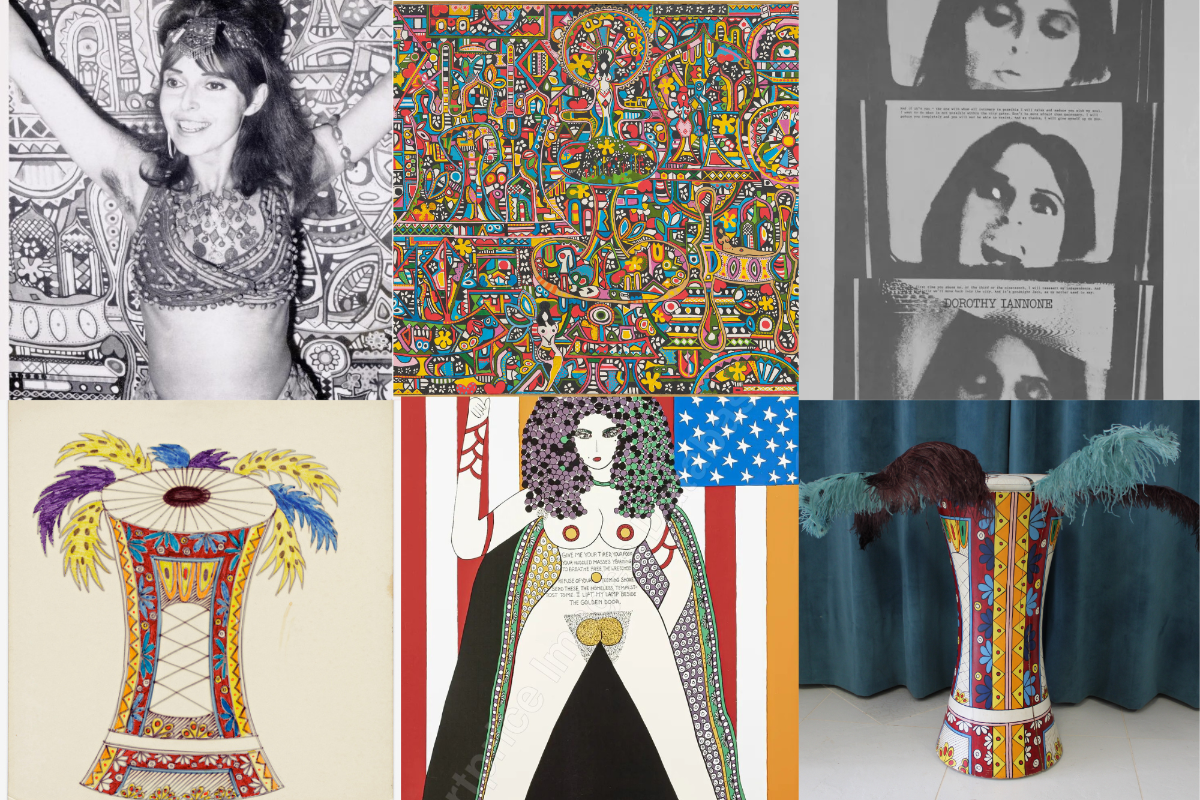
-Dorothy Iannone photographed by her husband James Upham in 1966
-Cap d’Antibes, 1966, acrylic on canvas
-Performance “I Was Thinking of You”, performed in Saint-Jeannet in 1975
-Stool, 1974, felt-tip pen on cardboard, Galerie Air de Paris
-Lady Liberty, lithograph
-Stool, 1975, lot 187 from our sale
Dorothy Iannone and the Artists of the French Riviera
In 1966, while in Antibes, Dorothy Iannone met Robert Filliou (1926–1987), artist and poet associated with the Fluxus movement, at the home of sculptor Albert Féraud (1921–2008), renowned for his stainless-steel works. During this stay, she created the painting Cap d’Antibes (130 x 162 cm, private collection) as well as the song Antibes Automatic. Through Filliou, she later encountered conceptual artist George Brecht (1926–2008), along with Daniel Spoerri (1930–2024) and Ben Vautier (1935–2024), all active figures on the Côte d’Azur artistic scene.
These artists, closely connected to the Fluxus movement, bear witness to the remarkable artistic effervescence that animated the French Riviera throughout the 1960s, where friendships and collaborations played a decisive role in creative experimentation. They gathered notably around the “Fluxus Festival” organised by Ben in Nice in 1963 following his meeting with George Maciunas (1931–1978), founder of the movement, and later within the “Centre international de création permanente”, also known as “La Cédille qui sourit”, established in Villefranche-sur-Mer by Robert Filliou and George Brecht between 1965 and 1968. Fluxus sought to break away from traditional forms of art through performances and freer, less elitist modes of expression.
Artistic Emulation in the Village of Saint-Jeannet
In the early 1970s, Robert Filliou settled in the hilltop village of Saint-Jeannet above Nice, where he founded the “Territory No. 2 of the Genius Republic”, a social utopia placing art at the heart of everyday life. There he reunited with Dorothy Iannone and George Brecht, and together they contributed to the magazine arTitudes under the direction of art critic François Pluchart (1937–1988). Created in Saint-Jeannet in 1971, the publication ran until 1977 and became a major platform for body art, featuring artists such as Michel Journiac (1935–1995) and Gina Pane (1939–1990).
It is precisely in issues 30/31 of the magazine, published in Saint-Jeannet in early 1976, that Dorothy Iannone sheds light on the genesis of the work presented in our sale. In the interview entitled “Le cul dans les plumes”, the artist explains that George Brecht encouraged her to extend the motifs of her paintings beyond the pictorial frame, particularly the stool motif, which appears both in her compositions and in isolated drawings belonging to a series devoted to furniture. With the assistance of local architect Jean-Pierre Giovannelli, the concept materialised into a three-dimensional object in 1975: crafted from bent wood, the stool was then painted and embellished with feathers. Unsurprisingly, this artistic gesture recalls Brecht’s celebrated “Chair Events”, transforming an everyday object into a true work of art.
As Dorothy Iannone herself explains in the same interview, the fabrication of these chairs required considerable technical prowess, which explains why only a very limited number were produced, apparently no more than five or six examples. Very few seats created directly by the artist are documented today. A similar example to ours is held in the collections of the Centre Pompidou (Stool, 1975, inventory no. AM 2015-375), while an armchair using the same base structure is preserved by Galerie Air de Paris, which represents the artist (Armchair, 1975).
An Unprecedented Piece of Furniture by Dorothy Iannone at Auction in Saint-Paul de Vence
The presentation at auction of a piece of furniture created by Dorothy Iannone constitutes an unprecedented event on the art market. Indeed, the works most commonly encountered are her prints, such as the celebrated Lady Liberty, her colourful erotic scenes, or her small painted wooden sculptures from the “People” series depicting various characters, and more rarely paintings. No piece of furniture by the artist had ever before appeared at auction, making this discovery an opportunity to reveal a lesser-known dimension of an artist who has been increasingly celebrated by major museums and institutions in recent years.
Dorothy Iannone was notably the subject of a monographic exhibition at the Centre Pompidou in 2019 entitled “Toujours de l’audace”, followed by another major exhibition at the Louisiana Museum in Copenhagen in 2022. In 2023, the artist also participated in the “Lady Dior Art” project by customising the fashion house’s iconic handbag. More recently, in 2026, her work is being exhibited in Madrid at the Dos de Mayo Art Centre.
Our Stool, created by the artist in 1975 and originating from a private collection in Saint-Jeannet, will be offered at auction in Saint-Paul de Vence on Saturday, June 6, 2026, during a sale dedicated to 20th Century Art.
-Dorothy Iannone photographed by her husband James Upham in 1966
-Cap d’Antibes, 1966, acrylic on canvas
-Performance “I Was Thinking of You”, performed in Saint-Jeannet in 1975
-Stool, 1974, felt-tip pen on cardboard, Galerie Air de Paris
-Lady Liberty, lithograph
-Stool, 1975, lot 187 from our sale
|
