
20231002173920.jpg)

FREE CLAUDE MONET ARTWORK APPRAISAL – VALUATION & AUCTION SERVICES IN SAINT-PAUL-DE-VENCE
Claude Monet: painting not simply the landscape, but light itself
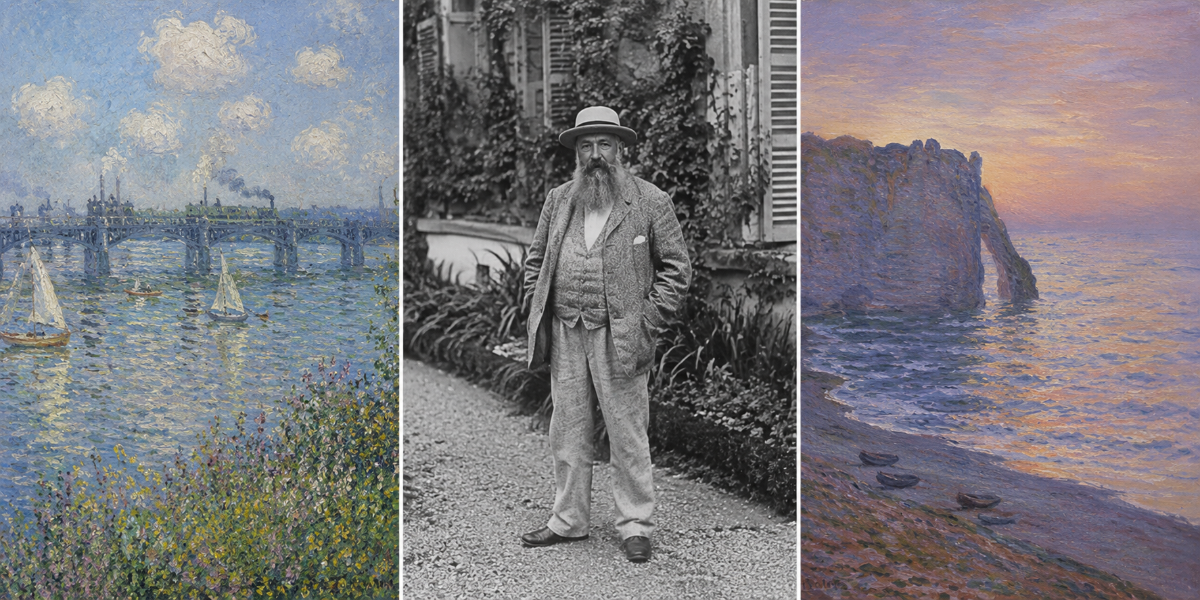
Claude Monet (1840–1926) is inseparable from the history of Impressionism—to such an extent that one painting, Impression, Sunrise, inadvertently gave the movement its name. Yet to regard Monet merely as one of the founders of Impressionism would be to overlook the scope of an artistic investigation pursued for more than sixty years: the endless transformation of nature through light, time and atmosphere.
Oscar-Claude Monet was born in Paris on 14 November 1840 but grew up in Le Havre, where his family settled in 1845. As a teenager, he first gained local recognition for his caricatures. His encounter with Eugène Boudin, around 1856–1858, proved decisive. Boudin introduced the young artist to painting en plein air and taught him to observe directly the changing effects of sky, sea and weather. Monet would remain deeply conscious of his debt to his first master.¹
Following military service in Algeria and another important encounter, with the Dutch painter Johan Barthold Jongkind, Monet joined Charles Gleyre's studio in Paris. There he met Renoir, Sisley and Bazille. This generation of young artists gradually sought to free itself from the conventions of studio painting and the official Salon, choosing instead to work directly before the motif.
The 1860s were still marked by financial difficulties and experimentation. Yet several defining characteristics of Monet's art were already emerging: painting outdoors, an increasingly free handling of paint and, above all, the desire to capture not simply what one knows about a landscape, but what the eye perceives at a particular moment.
From Impression, Sunrise to Impressionism
Following the Franco-Prussian War of 1870, Monet spent time in London and the Netherlands before settling in Argenteuil. This period was fundamental to his development. The Seine, sailing boats, bridges, gardens and the transformation of the landscape by modern life provided him with an extraordinary pictorial laboratory.
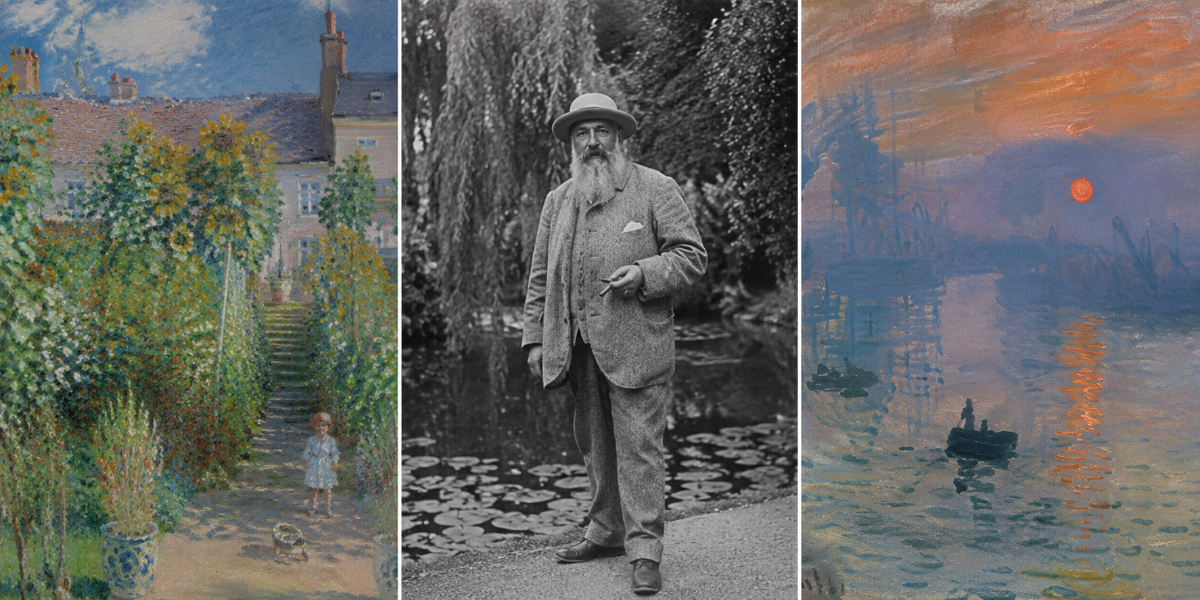
In 1874, Monet participated in the first exhibition organised by the Société anonyme des artistes peintres, sculpteurs et graveurs. Among the works exhibited was Impression, Sunrise, painted at Le Havre. The critic Louis Leroy mocked the title and referred derisively to the exhibitors as “Impressionists”. A term initially intended as ridicule entered the history of art.²
What some contemporaries regarded as unfinished painting was, in reality, a profound challenge to traditional representation. In Monet's work, contours gradually lose their autonomy; colour and light themselves construct pictorial space.
The subject remains important, but something else becomes essential: the visual experience of the subject.
This investigation led Monet to return repeatedly to the same motifs. From the late 1880s and particularly during the 1890s, the principle of the series became one of the major innovations of his work.
The Haystacks, Poplars and Rouen Cathedral series depict the same subjects under different conditions of light, season and atmosphere. Monet is no longer simply painting a cathedral or a haystack: he is painting the transformations imposed upon them by time.
Giverny and the Water Lilies: the culmination of a lifelong pursuit
In 1883, Claude Monet settled in Giverny, where he would remain until his death in 1926. There he gradually transformed his surroundings. As passionate about horticulture as he was about painting, he developed the Clos Normand and subsequently created his celebrated water garden.
The garden was not simply the setting for his later paintings. In a sense, Monet created the subject before he painted it.
In 1924, Gustave Geffroy offered a particularly evocative description:
“From the top of a wisteria-covered bridge, which happens to be Japanese in style, Monet comes to contemplate the picture he has created.”³
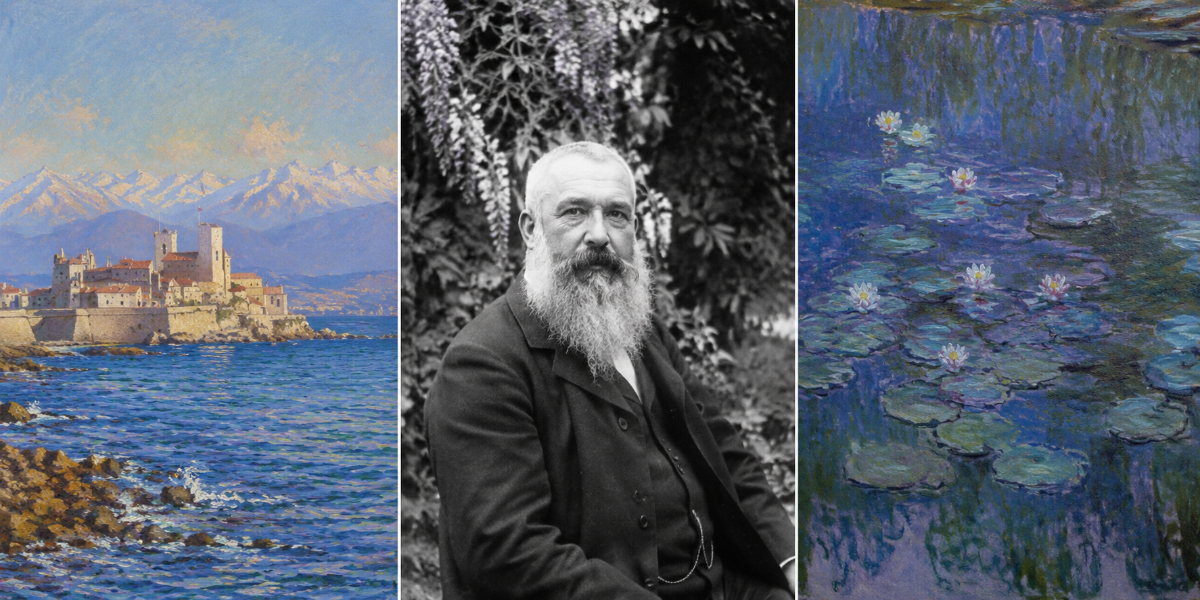
From 1897 onward, the Water Lilies occupied an increasingly important place in Monet's work. The pond, aquatic plants, willows, Japanese bridge and, above all, reflections became the starting point for a radical transformation of pictorial space.
Gradually, the horizon disappears. The sky is sometimes no longer represented directly but appears through its reflection in the water. It becomes increasingly difficult to distinguish what lies above, below or upon the surface.
The monumental late Water Lilies, culminating in the ensembles now housed at the Musée de l'Orangerie in Paris, therefore extend far beyond the traditional conventions of landscape painting. Through their scale, their immersive relationship with the viewer and the progressive dissolution of the motif, they would exert a profound influence on subsequent generations of 20th-century artists.
Claude Monet and the Mediterranean: Bordighera, Monaco and Antibes
Although Normandy, the Seine and Giverny occupy a fundamental place in the popular image of Monet, his work also has an important relationship with the Mediterranean and the French Riviera.
In 1883, Monet explored the Mediterranean coast with Renoir, travelling through the region around Monaco. The following year, he returned alone to Bordighera on the Italian Riviera. Its luxuriant vegetation and intense light, so different from the atmospheric conditions of Normandy, presented him with new pictorial challenges.
In 1888, Monet returned to the French Riviera and spent several months in Antibes. The bay, the fortified old town, the distant Alps, pine trees and Mediterranean light provided a new range of subjects.
These southern campaigns occupy an important position in Monet's artistic development. His palette intensified: pinks, blues, violets and greens respond to a quality of light whose particular character Monet once again sought to capture.
For an auction house based in Saint-Paul-de-Vence, this history has particular resonance. Our location in the heart of the French Riviera places us within a region historically associated with major collections of Impressionist, Modern and Contemporary art.
From Saint-Paul-de-Vence, we assist collectors, families and owners in the appraisal and sale of their artworks, while ensuring that major works are presented to a national and international market.
Our expertise in works by Claude Monet
Specialist assessment for an important work of art
Owning a work by Claude Monet—or discovering a painting bearing his signature—requires an approach considerably more rigorous than that applicable to an ordinary work of art.
Our auction house in Saint-Paul-de-Vence assists owners with the appraisal, research and sale of works by Claude Monet, as well as with the preliminary assessment of paintings and works on paper attributed to the artist.
For a work of this importance, value cannot be established from a signature alone, nor from a superficial comparison with a handful of auction results. A serious assessment must combine art-historical research, provenance, documentary evidence, physical examination and a detailed understanding of the international art market.
Free, confidential and tailored appraisal
You may submit photographs of your artwork to receive a preliminary, confidential and no-obligation assessment.
Our initial appraisal takes into consideration:
-medium and support;
-subject and composition;
-dimensions;
-presumed date and period of execution;
-signature and any inscriptions;
-condition;
-known provenance;
-labels, stamps and inscriptions on the reverse;
-historic invoices and correspondence;
-exhibition history and published references;
-recent international auction results for genuinely comparable works.
Where further research is required, we discuss with the owner the appropriate investigations before considering any sale.
Claude Monet catalogue raisonné, provenance and authentication
For Claude Monet, provenance is of fundamental importance.
The catalogue raisonné compiled by Daniel Wildenstein, published in several volumes from 1974 onward and subsequently supplemented, remains a major bibliographical reference for the study of Monet's work.⁴ The inclusion of a painting in the catalogue raisonné, together with its ownership history, exhibition history and bibliography, contributes to the scholarly documentation of the work.
However, the absence of a work from known documentation should lead neither to a hasty conclusion nor to a promise of authenticity. It calls for careful and methodical research.
An old gallery label, inventory number, archival photograph, invoice, correspondence or documented family provenance may sometimes provide the first clues from which the history of a painting can be reconstructed.
A “Claude Monet” signature alone is never sufficient to authenticate a work.
We therefore advise owners of paintings attributed to Monet to preserve all documentation, original frames, labels, stamps and inscriptions associated with the work.
Types of Claude Monet artworks we appraise
Paintings and oils on canvas
Paintings naturally form the core of the market for Claude Monet.
Their value can vary dramatically according to date, subject, artistic quality, dimensions and provenance. Works belonging to Monet's most celebrated groups and series—including the Haystacks, Poplars, Rouen Cathedrals, London views, Giverny gardens and Water Lilies—occupy a particularly important position on the international art market.
Yet the importance of a Monet cannot be reduced solely to its inclusion in a famous series. Views of Normandy, landscapes along the Seine, snow scenes, Mediterranean compositions and early works may possess considerable artistic and historical significance.
Drawings and works on paper
Monet's drawings reveal a more intimate aspect of his artistic practice.
Pencil drawings, studies and early works on paper require the same careful approach as his paintings. The paper itself, possible watermarks, provenance, inscriptions and connections with documented works may all contribute to their assessment.
Pastels
Claude Monet's pastels constitute a rarer and highly sought-after part of his oeuvre.
Several are associated with the landscapes of Normandy and reveal his exploration of colour and atmospheric effects. Their inherent fragility makes the examination of condition, support and provenance particularly important.
Works attributed to Claude Monet
Do you own a painting signed Claude Monet, an artwork traditionally attributed to the artist within your family, or a painting whose authorship remains uncertain?
We can carry out a preliminary assessment of the work and its documentation.
It is important to distinguish between a valuation, which seeks to determine the likely market value of an identified artwork, and authentication research, which seeks to establish or clarify its attribution.
In the case of Claude Monet, this distinction is essential.
Claude Monet prices and the international art market
Claude Monet belongs to the very small group of artists whose masterpieces stand among the benchmarks of the international art market.
His market is underpinned by his pivotal role in the development of Impressionism, the presence of his works in the world's leading museums and private collections, and the rarity of major paintings still capable of returning to the market.
It would, however, be misleading to suggest that there is a single, uniform “Claude Monet price” or market value.
Two Monet paintings of comparable dimensions can achieve radically different prices.
The value of a Claude Monet artwork depends particularly on:
-its date and period;
-subject;
-importance within the artist's development;
-artistic quality and condition;
-provenance;
-exhibition history;
-bibliography;
-inclusion in the catalogue raisonné;
-and the level of competition that can be generated among collectors at auction.
Major paintings by Claude Monet can command millions or tens of millions of euros, while his most exceptional works occupy the very highest level of the international Impressionist market.
In this context, the sales strategy is crucial.
An important work must be researched, positioned, presented and promoted to the collectors most likely to understand and pursue it. Our role as an auction house is precisely not to treat a major work as merely another lot: its history, provenance and position within Monet's oeuvre must become central to its presentation on the market.
Why sell a Claude Monet artwork in Saint-Paul-de-Vence?
The successful sale of an important artwork is no longer determined solely by the geographical location of the saleroom in which it is offered. International online bidding and digital communications now make it possible to bring together collectors from France, Europe, the United States, Asia and beyond.
Nevertheless, the context in which an artwork is presented remains highly significant.
Saint-Paul-de-Vence and the French Riviera have enjoyed a privileged relationship with collectors and the history of modern art for more than a century. Monet himself was profoundly affected by Mediterranean light during his painting campaigns in Bordighera, Monaco and Antibes.
From Saint-Paul-de-Vence, our auction house therefore combines a location within one of France's great territories of modern art with the international reach required for the sale of an important artwork.
When entrusted with a work by Claude Monet, our objective is not simply to find a buyer. It is to create the conditions in which the most relevant collectors can compete for the work, with the aim of achieving the best possible auction result.
How can I get a Claude Monet artwork appraised?
1-Contact us for a free and confidential preliminary appraisal.
2-Send us photographs of the artwork: overall view, signature, front, reverse, frame, labels and relevant details.
3-Provide any documentation available: historic invoices, certificates, inventories, correspondence, photographs, exhibition catalogues or inheritance records.
4-We undertake a preliminary assessment of the artwork and its provenance.
5-Where appropriate, a physical examination and further documentary research can be arranged.
6-Once the work has been studied, we define with you the most appropriate sale and international marketing strategy.
👉 Request a free appraisal of your Claude Monet artwork or a painting attributed to Monet.
For a preliminary remote assessment, you may complete our online valuation form.
To have your artwork examined in person, please consult the calendar of our valuation days or contact our auction house in Saint-Paul-de-Vence.
FAQ – CLAUDE MONET APPRAISAL, AUTHENTICATION & SALE
How much is my Claude Monet painting worth?
The value of a Monet depends on its period, subject, medium, dimensions, condition, provenance, exhibition history and bibliography. For major paintings, belonging to a particularly important series or sought-after period can have a considerable impact on market value. A reliable valuation therefore requires an individual assessment of the artwork and comparison with genuinely relevant auction results.
How can I tell if a painting signed Monet is authentic?
A signature is an element to be examined, but a Monet signature alone does not authenticate a painting. Research must consider the technique, support, style, provenance and documentary history of the artwork, including its possible inclusion in the catalogue raisonné.
Is there a catalogue raisonné of Claude Monet's work?
Yes. Daniel Wildenstein compiled the catalogue raisonné of Claude Monet in several volumes. It is a fundamental reference for the study of Monet's paintings, drawings and pastels. The first volume was published in 1974.⁴
I inherited a painting signed Claude Monet. What should I do?
Avoid cleaning, restoring or otherwise altering the painting, and preserve its frame together with any labels, stamps or inscriptions on the reverse. Photograph the front, back, signature and all documentary evidence. A preliminary assessment can then determine whether further research is appropriate.
Can you appraise a Claude Monet from photographs?
Yes. Good-quality photographs can provide the basis for a preliminary remote appraisal. For a work potentially by Claude Monet, however, physical examination and documentary research will generally be necessary before any definitive conclusion or proposed sale.
What documents are important when researching a Monet?
Historic invoices, certificates, photographs, correspondence, estate inventories, exhibition catalogues and labels from galleries, collectors or transport companies can all provide valuable evidence. Provenance is an essential element in both the study and valuation of an artwork.
What is the current market value of Claude Monet?
There is no single market value for Claude Monet. Major paintings can achieve tens of millions of euros, while values vary considerably according to medium, period, subject, provenance and historical importance. A meaningful valuation must therefore be based on genuinely comparable works rather than an average price.
Where should I sell a Claude Monet painting?
For an artwork of this importance, the choice of auction house should take into account its ability to research and document the work, develop an international marketing strategy and reach collectors of Impressionist art capable of competing for it.
Why sell a Claude Monet artwork in Saint-Paul-de-Vence?
Saint-Paul-de-Vence lies at the heart of a region historically associated with major collections of Impressionist and Modern art. Monet himself worked on the French Riviera, notably in Antibes in 1888. Our location enables us to combine close relationships with collectors on the Côte d'Azur with national and international exposure for the sale.
How much does an initial Claude Monet appraisal cost?
Our preliminary appraisal is free, confidential and without obligation. If scientific analysis, specialist research or other investigations subsequently become necessary, these can be considered with the owner according to the individual requirements of the artwork.
For remote appraisals, you may fill out our online evaluation form.
To have your treasures assessed, consult our appraisal day calendar or contact us directly.
Bibliographic References
1-Daniel Wildenstein, Claude Monet. Biographie et catalogue raisonné, 5 vols., Lausanne/Paris, La Bibliothèque des Arts, 1974–1991.
2-Daniel Wildenstein, Monet or the Triumph of Impressionism, Cologne, Taschen.
3-Gustave Geffroy, Claude Monet, sa vie, son œuvre, Paris, 1924; reprinted Paris, Macula, 1980.
4-Daniel Wildenstein, Claude Monet. Biographie et catalogue raisonné, op. cit. The catalogue comprises five volumes covering Monet's paintings and, in its final volume, supplements, drawings, pastels and indexes.
5-Musée de l'Orangerie, Paris, documentation on Claude Monet and the Water Lilies cycle.
6-Claude Monet's House and Gardens, Giverny, Académie des beaux-arts, historical documentation and chronology of Claude Monet.