
20231002173920.jpg)

FREE RENÉ LALIQUE APPRAISAL – VASES, JEWELLERY, GLASSWARE & AUCTION SALES
René Lalique: From Art Nouveau Jewellery to Art Deco Glass
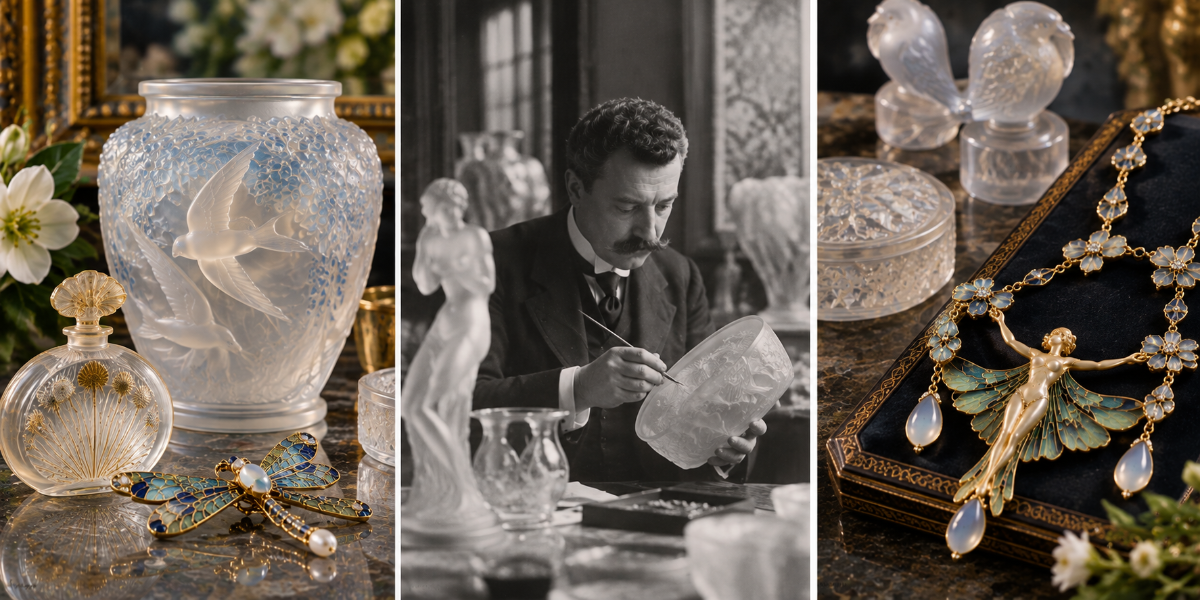
René Lalique (1860–1945) holds a unique position in the history of French decorative arts. A jeweller, designer, glassmaker and industrialist, he played a leading role in two major artistic movements: Art Nouveau and Art Deco.
Throughout his career, Lalique sought to transform traditional materials and techniques, elevating decorative objects into works of art.
Born in Aÿ, in the Champagne region of France, René Lalique began his apprenticeship with the jeweller Louis Aucoc in 1876. He continued his training in Paris and England before working as a designer for prestigious jewellery houses, including Boucheron and Cartier.
In 1885, he took over the workshop of jeweller Jules Destapes and began developing his own distinctive artistic language.
René Lalique and the Birth of Modern Jewellery
During the late nineteenth century, René Lalique revolutionised jewellery design.
At a time when the value of jewellery was largely determined by the preciousness of its materials, Lalique placed artistic imagination, craftsmanship and originality at the centre of his creations.
Gold, diamonds and gemstones were combined with enamel, horn, ivory, glass and semi-precious stones.
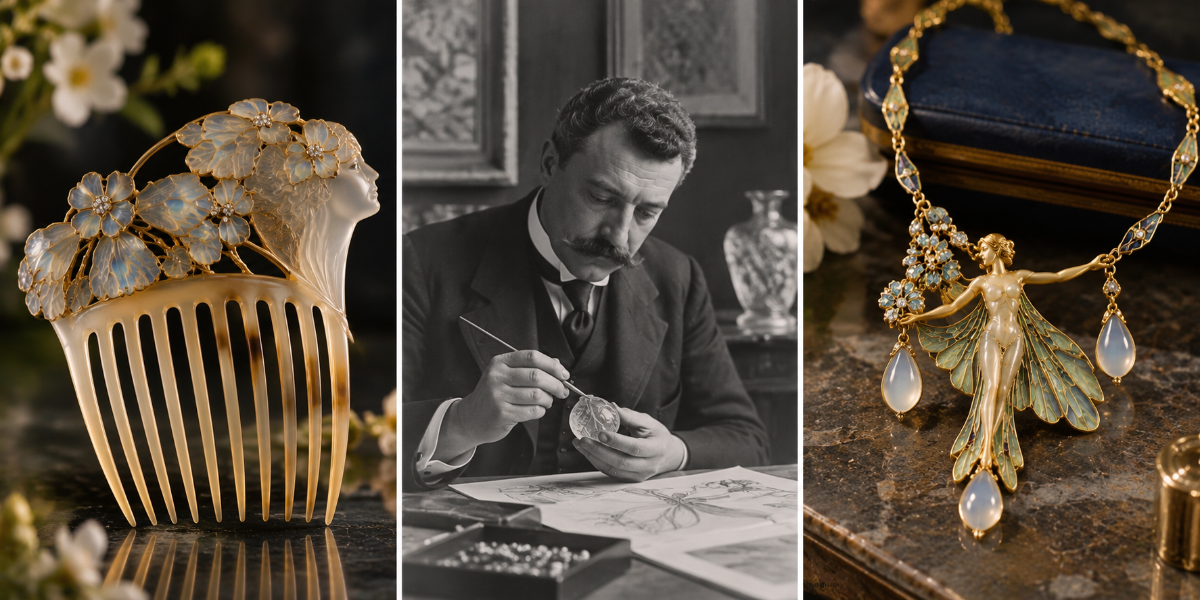
Dragonflies, snakes, orchids, poppies, insects and female figures became recurring motifs, reflecting the influence of nature, Symbolism and Art Nouveau.
His creations attracted prominent clients and collectors, including the actress Sarah Bernhardt and the art collector Calouste Gulbenkian.
The Paris Exposition Universelle of 1900 established his international reputation.
Today, original René Lalique Art Nouveau jewellery is among the most sought-after creations in the history of decorative jewellery. Its rarity, artistic originality and exceptional craftsmanship explain the remarkable prices achieved by important pieces at auction.
René Lalique: A Master of Art Deco Glass
At the beginning of the twentieth century, René Lalique increasingly turned his attention to glassmaking.
His collaboration with perfumer François Coty, which began in 1907, marked a decisive turning point.
Lalique designed perfume bottles whose shapes and decorative details became an integral part of the fragrance's identity. The bottle itself was transformed into a work of art.
He subsequently expanded his production to include decorative vases, bowls, sculptures, perfume bottles, lighting, clocks and tableware.
In 1921, he established a new glassworks in Wingen-sur-Moder, Alsace.
The International Exhibition of Modern Decorative and Industrial Arts in Paris in 1925 confirmed his central role in the development of Art Deco.
Lalique also contributed to prestigious decorative projects, including luxury ocean liners and trains.
His glass creations combined industrial innovation with exceptional artistic refinement.
Opalescent glass, moulded and pressed glass, coloured glass, patination and sophisticated effects of transparencybecame defining features of his work.
HOW TO IDENTIFY AN AUTHENTIC RENÉ LALIQUE PIECE
Identifying an authentic René Lalique object requires careful examination of its design, manufacturing technique, signature, production period and condition.
One of the most important distinctions concerns pieces produced during René Lalique's lifetime and those manufactured by the Lalique company after his death.
What Is the Difference Between R. Lalique and Lalique France?
This distinction is particularly important when determining the value of a Lalique object.
Pieces produced during René Lalique's lifetime, before 1945, may bear signatures such as “R. Lalique”, “R. Lalique France” or other variations depending on the model and period.
Following René Lalique's death, his son Marc Lalique continued the company's activities and notably developed the production of crystal glass.
The signature “Lalique France” is generally associated with later production, although the precise identification of an object must always take its design and manufacturing characteristics into account.
An antique R. Lalique vase and a later Lalique France crystal vase may therefore have significantly different market values.
However, a signature alone does not establish authenticity.
Signatures can be imitated, altered or added, while certain historical designs continued to be manufactured in later periods.
The signature must therefore be assessed alongside the manufacturing technique, the characteristics of the model and published reference material.
Félix Marcilhac's René Lalique: Catalogue Raisonné de l'Œuvre de Verre is an essential reference for identifying René Lalique glass creations.
RENÉ LALIQUE PRICES AND MARKET VALUE
The market for René Lalique is remarkably diverse.
Prices vary considerably between a relatively common perfume bottle, a desirable Art Deco vase, an opalescent glass sculpture and an exceptional Art Nouveau jewel.
There is no single market price for René Lalique: each category has its own collectors, characteristics and auction market.
René Lalique Vase Appraisal and Auction Prices
Vases are among the most sought-after categories of René Lalique glassware.
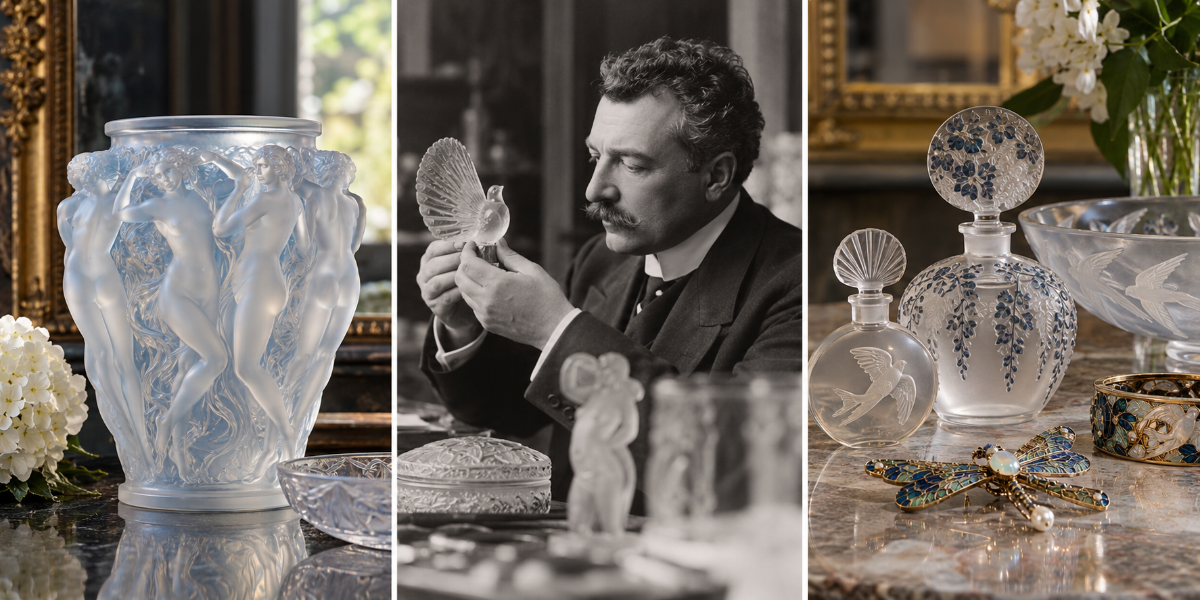
Iconic designs such as Bacchantes, Tourbillons, Serpent, Perruches and Sauterelles occupy an important place in Art Deco collections.
The value of a René Lalique vase depends on its rarity, colour, patina, dimensions, condition and production period.
Antique examples in opalescent glass or particularly desirable colours can command substantial prices.
Exceptional pieces may sell for several tens of thousands of euros, while more common models achieve considerably lower amounts.
Having a Lalique vase professionally appraised is essential to establish its precise model and period of manufacture.
René Lalique Jewellery Appraisal
René Lalique's Art Nouveau jewellery belongs to a distinct market from his glass creations.
Brooches, pendants, necklaces, combs, rings and hatpins may combine gold, enamel, glass, gemstones and unconventional materials.
Their value depends on artistic quality, rarity, provenance and condition.
Major original creations can achieve several hundred thousand euros at auction, or even higher prices in exceptional cases.
A piece of jewellery signed René Lalique therefore requires particularly careful examination, especially when its attribution or date has not been established.
Lalique Perfume Bottles: Appraisal and Value
Perfume bottles represent an essential part of René Lalique's glassmaking career.
Created for perfume houses including Coty, Worth and Roger & Gallet, these objects combine technical innovation with decorative sophistication.
Their value depends on the model, rarity, age, condition and the presence of the original stopper and labels.
Some relatively common antique perfume bottles may sell for a few hundred euros, while rare and highly desirable models can achieve several thousand euros or more.
Original stoppers, labels and packaging should always be preserved, as they may significantly influence the object's value.
Lalique Sculptures, Lighting and Car Mascots
René Lalique also designed glass sculptures, clocks, bowls, wall lights, chandeliers, lamps and architectural decorative elements.
His celebrated automobile radiator mascots, also known as Lalique car mascots or hood ornaments, have become a specialised collecting category.
Models such as Victoire, Vitesse and Spirit of the Wind are particularly representative of Art Deco design.
Their market value depends on authenticity, rarity, colour, model and condition.
Lalique tableware, including glasses, decanters, bowls, plates and complete services, also attracts collectors.
For these objects, the completeness of a set and its overall condition are especially important.
WHAT DETERMINES THE VALUE OF A RENÉ LALIQUE OBJECT?
Whether you own a vase, a piece of jewellery or a perfume bottle, several factors influence its appraisal:
-Production period: an original creation from René Lalique's lifetime or a later production.
-Model and rarity: certain designs are considerably more sought after than others.
-Signature: its form, position and consistency with the production period.
-Manufacturing technique: pressed glass, opalescent glass, coloured glass, enamel or precious materials.
-Colour: certain colour variations may command substantial premiums.
-Condition: chips, cracks, restorations, missing elements or alterations.
-Provenance: original invoices, private collections, documentation or previous auction history.
Comparable auction results: prices achieved by similar pieces of the same period and condition.
A Lalique object should never be valued solely on its appearance or dimensions.
Two examples of the same design may achieve significantly different prices depending on their colour, condition and age.
HOW TO GET A RENÉ LALIQUE VASE, JEWEL OR GLASS OBJECT APPRAISED
Saint Paul Auction, based in Saint-Paul-de-Vence on the French Riviera, offers free and confidential preliminary appraisals of René Lalique artworks and decorative objects.
To request an appraisal, please provide:
-Clear photographs showing the entire object.
-Close-up photographs of the signature or hallmark.
-Accurate dimensions.
-Photographs of the base, reverse and any original labels.
-Information about the object's condition.
-Any available details concerning its provenance or family history.
-For jewellery, photographs of hallmarks, clasps and possible maker's marks are particularly helpful.
-For glassware, we recommend photographing the base, signature and any damage.
Do not restore, polish or alter an antique Lalique object before seeking professional advice. Inappropriate restoration or cleaning may affect its original characteristics and reduce its market value.
An initial assessment can generally be made from photographs. A physical examination may subsequently be necessary to confirm authenticity, condition and the production period.
SELL RENÉ LALIQUE AT AUCTION IN SAINT-PAUL-DE-VENCE
The market for René Lalique attracts an international audience of collectors specialising in Art Nouveau, Art Deco, antique jewellery and decorative glass.
However, the diversity of his production calls for different sales strategies.
An exceptional Art Nouveau jewel, a rare opalescent glass vase and a collection of antique perfume bottles do not necessarily appeal to the same buyers.
Located in Saint-Paul-de-Vence, in the Alpes-Maritimes department of southern France, Saint Paul Auction assists private owners, collectors and families wishing to appraise and sell René Lalique works.
The French Riviera, Monaco and Provence are home to numerous private collections of antique jewellery, glassware and nineteenth- and twentieth-century decorative arts.
Our aim is to combine this regional presence with national and international auction exposure, presenting each object to collectors with a particular interest in its category.
An appropriate valuation, an accurate catalogue description and competitive bidding are essential elements of a successful auction sale.
Do you own a René Lalique vase, jewel, sculpture or perfume bottle?
Request your free and confidential René Lalique appraisal today. You can submit photographs through our online valuation form or arrange an appointment at our auction house in Saint-Paul-de-Vence.
For remote appraisal requests, you can fill out our online form.
To have your treasures valued in person, check our appraisal day calendar or contact us directly.
FAQ – RENÉ LALIQUE APPRAISAL, AUTHENTICATION & AUCTION PRICES
How much is my René Lalique vase worth?
The value of a René Lalique vase depends on its design, age, colour, manufacturing technique and condition. Common models may be worth a few hundred or several thousand euros, while rare antique examples can achieve several tens of thousands of euros at auction. A professional appraisal helps identify the exact model and compare it with relevant auction results.
How can I tell if my René Lalique piece is authentic?
Authentication involves examining the design, manufacturing technique, signature and characteristics of the glass. The presence of an “R. Lalique” signature alone does not guarantee authenticity. Comparison with documented models in Félix Marcilhac's catalogue raisonné is particularly useful.
What is the difference between R. Lalique and Lalique France?
“R. Lalique” signatures are generally associated with antique pieces produced during René Lalique's lifetime, while “Lalique France” is usually associated with production after 1945. This distinction can have a significant effect on market value, but the object's model, manufacturing technique and period must also be considered.
How much is an original René Lalique Art Nouveau jewel worth?
Original René Lalique jewellery is highly sought after by collectors. Its value depends on rarity, design, materials, condition and provenance. Important creations can achieve several hundred thousand euros at auction. Specialist examination is essential when attribution or authenticity remains uncertain.
How much is an antique Lalique perfume bottle worth?
The price of an antique Lalique perfume bottle depends on its design, rarity, age and condition. The presence of the original stopper and labels may significantly affect its value. Some examples sell for a few hundred euros, while rare models can achieve several thousand euros or more.
How can I identify a René Lalique vase model?
Identification is based on the vase's shape, decoration, dimensions, colour and signature. Many antique René Lalique designs are documented in Félix Marcilhac's catalogue raisonné. Clear photographs of the vase and its base usually provide a useful starting point.
Are René Lalique car mascots valuable?
Yes. René Lalique automobile mascots are sought-after Art Deco collectibles. Their value depends on the design, rarity, colour, condition and authenticity. Rare examples can achieve substantial prices at auction.
Can I get a René Lalique appraisal from photographs?
Yes. Saint Paul Auction offers a free preliminary appraisal based on photographs and information supplied by the owner. A physical examination may be required to confirm authenticity, condition and production period.
I inherited an object signed Lalique. What should I do?
Keep the object in its current condition and avoid restoration. Photograph it from several angles, including the signature and base. Look for original invoices, boxes, labels or family documents. An initial appraisal can help establish whether it is an antique René Lalique creation or a later production.
Where can I sell a René Lalique vase or piece of jewellery?
Selling at auction allows René Lalique objects to reach specialist collectors and benefit from competitive bidding. The choice of auction house should take into account its ability to identify the object accurately, establish a realistic valuation and promote the sale to French and international buyers.
How much does a René Lalique appraisal cost?
Our initial René Lalique appraisal is free, confidential and without obligation. It can be carried out remotely using photographs or during an appointment at our auction house in Saint-Paul-de-Vence.
BIBLIOGRAPHY & REFERENCES
1-Félix Marcilhac, René Lalique, 1860–1945: Maître-verrier. Analyse et catalogue raisonné de l'œuvre de verre, Paris, Les Éditions de l'Amateur, revised and expanded edition, 2011.
2-Sigrid Barten, René Lalique. Schmuck und Objets d'art 1890–1910, Munich, Prestel, 1977.
3-Musée Lalique, Wingen-sur-Moder, France. Historical documentation on René Lalique, Art Nouveau jewellery and Art Deco glassmaking.
4-Maison Lalique, historical archives and chronology of René Lalique, including jewellery design, collaborations with perfume houses and the development of the Alsace glassworks.