
20231002173920.jpg)

FREE CÉSAR BALDACCINI ARTWORK APPRAISAL – SCULPTURES, COMPRESSIONS, THUMB SCULPTURES & AUCTION SALES
César Baldaccini: From Marseille to Nouveau Réalisme
César Baldaccini was born in 1921 in the Belle de Mai district of Marseille, southern France, into a family of Italian origin.
He studied at the École des Beaux-Arts in Marseille before continuing his artistic training at the École Nationale Supérieure des Beaux-Arts in Paris.
Following the Second World War, César developed a highly original approach to sculpture.
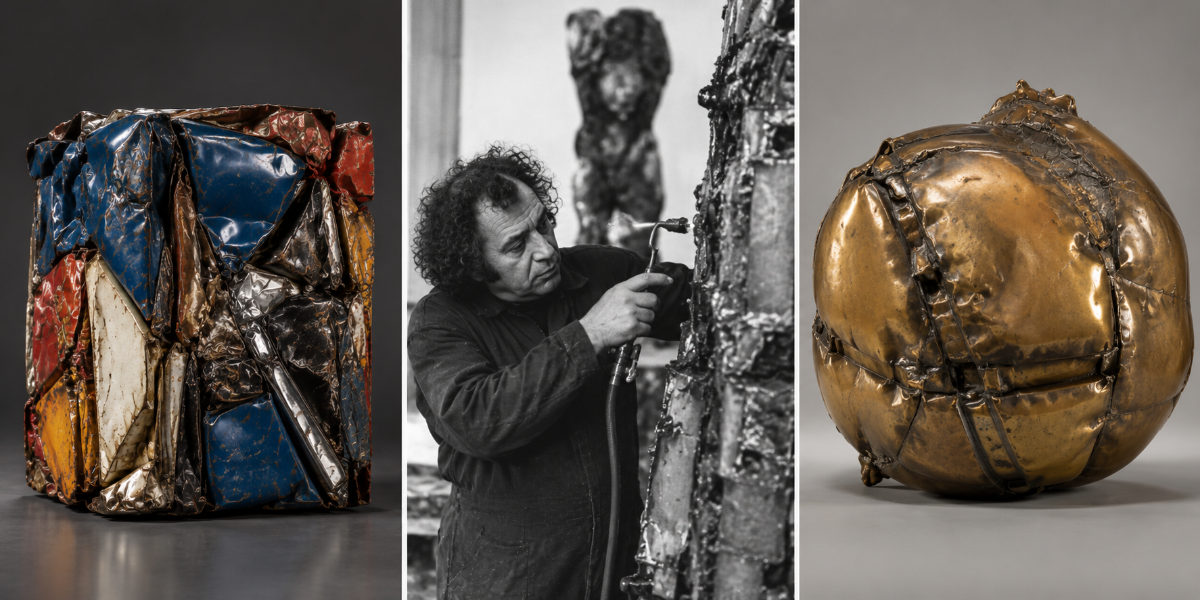
Unable to afford traditional sculptural materials, he began collecting discarded industrial metal and assembling it through welding.
His early sculptures depicted animals, insects and human figures, demonstrating remarkable technical skill and a fascination with transforming everyday materials into works of art.
César's Compressions and the Nouveau Réalisme Movement
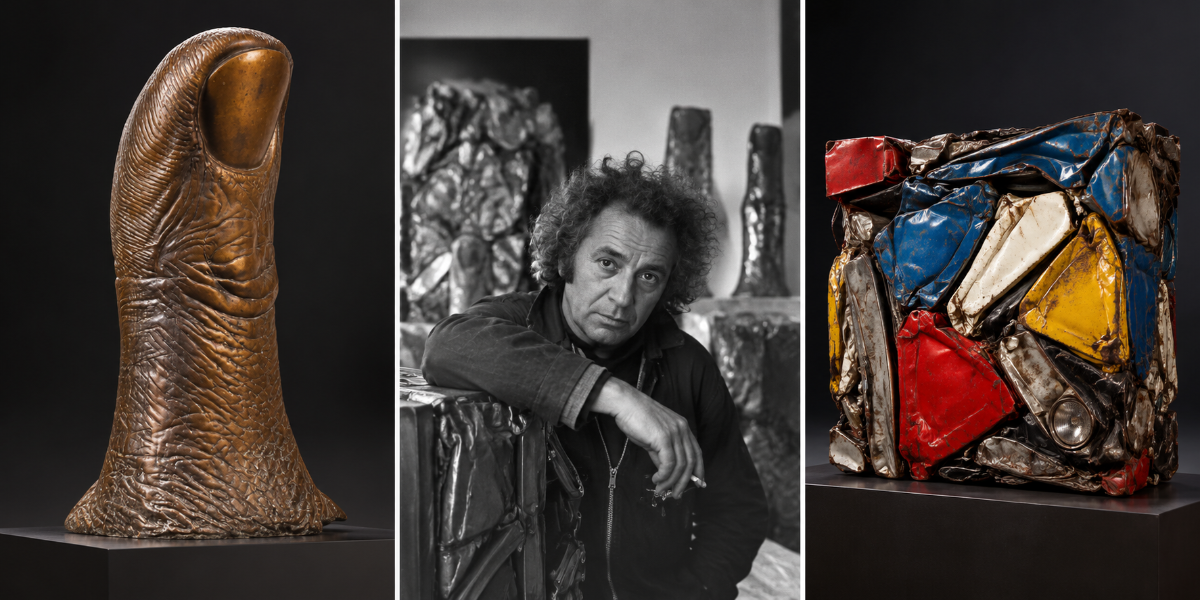
In 1960, César introduced his first Compressions, created using a hydraulic press to transform automobile bodies and industrial metal objects into compact sculptural forms.
This revolutionary process challenged traditional definitions of sculpture. Rather than modelling or carving the material directly, the artist organised its mechanical transformation.
That same year, César joined Nouveau Réalisme, the artistic movement established around critic Pierre Restany, whose members included Arman, Yves Klein, Jean Tinguely and Niki de Saint Phalle.
His Compressions quickly became emblematic of a new relationship between art, industry and consumer society.
The Thumb and Expansions: César's Most Iconic Works
In 1965, César created his celebrated Thumb (Le Pouce), based on an enlarged cast of his own thumb.
Produced in different sizes and materials, including bronze, the Thumb became one of the most recognisable sculptures in twentieth-century French art.
From 1967 onwards, César also developed his Expansions, using the expanding properties of polyurethane foam.
The material spread and solidified into organic, unpredictable forms, allowing César to explore the relationship between artistic intention and the physical behaviour of materials.
Internationally recognised, César is represented in major public collections.
He also designed the trophy awarded at the César Awards, the French national film awards established in 1976.
A Marseille-born artist with deep Mediterranean roots, César played a major role in renewing French sculpture through his innovative use of industrial materials and unconventional techniques.
HOW MUCH IS A CÉSAR BALDACCINI ARTWORK WORTH?
The market value of a César Baldaccini artwork varies considerably depending on its type, date, dimensions, materials, edition size and provenance.
A unique sculpture, an editioned bronze, a Compression and a drawing do not command the same prices on the international art market.
César Thumb Sculpture: Appraisal and Auction Prices
The Thumb is one of César's most celebrated and sought-after creations.
Produced in different sizes and materials, particularly bronze, it exists as monumental sculptures, collectible bronzes and smaller editions.
The value of a César Thumb sculpture depends on its dimensions, material, edition, numbering, foundry marks and provenance.
Authentic examples may achieve several tens of thousands of euros at auction, while particularly important sculptures can command significantly higher prices.
It is essential to distinguish authentic editions from decorative reproductions and objects merely inspired by César's iconic design.
César Compressions: Prices and Valuation
César's Compressions are among the most significant works of his career.
Created from automobile bodies, industrial metal and other compressed objects, they represent his innovative approach to sculpture.
Their value depends on the period of production, dimensions, materials, provenance and importance within the artist's work.
Historical Compressions from the 1960s occupy a particularly significant position in the international art market.
An original César Compression can achieve a substantial auction price, although each work must be assessed individually.
Welded Metal Sculptures, Animal Figures and Expansions
César's early welded metal sculptures, produced mainly during the 1950s, are particularly appreciated by collectors.
Chickens, fish, insects, imaginary animals and human figures demonstrate his exceptional ability to transform discarded metal into expressive sculptural forms.
These early creations are an essential part of his artistic development and can achieve significant prices at auction.
His Expansions, created using polyurethane foam, also have a specialised market.
Their valuation requires particular attention to condition and the long-term preservation of the materials.
César Drawings, Prints, Editions and Jewellery
César also produced drawings, works on paper, prints, limited editions and jewellery.
These categories provide different opportunities for collectors and can vary considerably in market value.
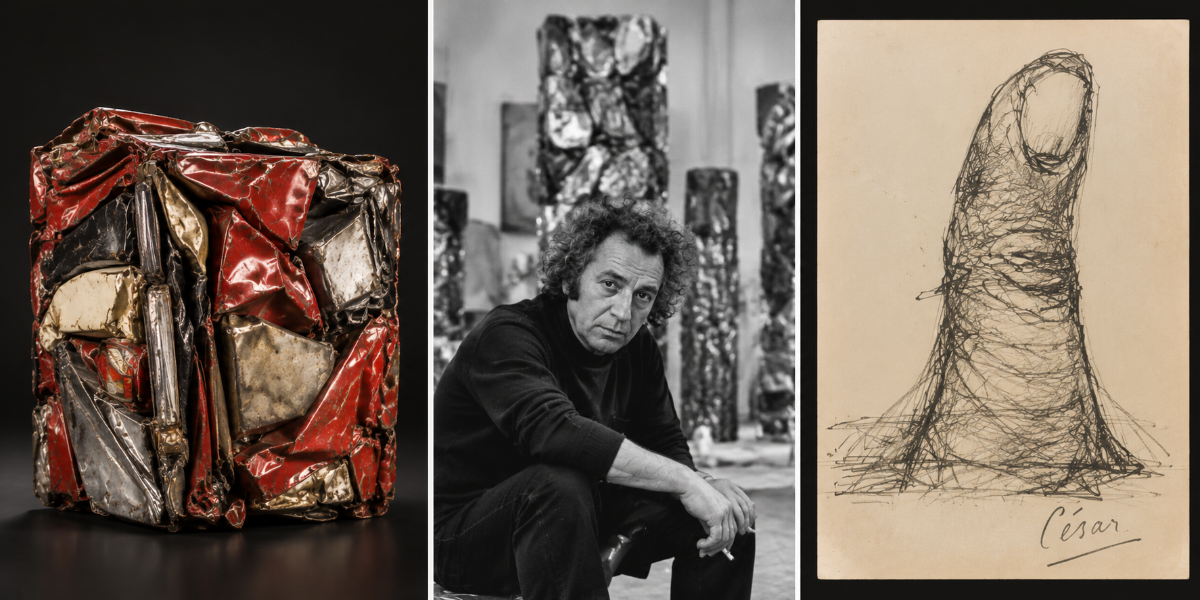
Original drawings signed César Baldaccini may be of particular interest when their authenticity and provenance are properly documented.
His jewellery, including pieces inspired by his Compressions, represents a distinctive collecting category at the intersection of contemporary art and artist-designed jewellery.
The value of these works depends on authenticity, rarity, technique and, in the case of editions, the number of examples produced.
HOW TO AUTHENTICATE A CÉSAR SCULPTURE OR DRAWING
Authenticating a work by César Baldaccini requires careful examination of its technique, signature, provenance, possible edition number and supporting documentation.
For bronze sculptures, dimensions, foundry marks and edition characteristics are particularly important.
For Compressions and other unique works, ownership history, historical photographs and exhibition references may provide essential evidence.
The archives of Denyse Durand-Ruel and other documentation relating to César's work play an important role in attribution research.
Depending on the artwork, consultation with the appropriate specialists or authentication authorities may also be necessary.
A signature reading “César” is not, by itself, sufficient proof of authenticity.
A preliminary specialist appraisal can help assess the artwork's characteristics and determine whether further research or authentication procedures are required.
SELL OR APPRAISE A CÉSAR BALDACCINI ARTWORK ON THE FRENCH RIVIERA
Located in Saint-Paul-de-Vence, in the Alpes-Maritimes department of southern France, Saint Paul Auction assists collectors, private owners and families wishing to obtain a valuation or sell a work by César Baldaccini.
Born and educated in Marseille, César has strong historical connections with southern France.
His sculptures also occupy an important place in modern and contemporary art collections, particularly those established on the French Riviera, in Monaco and throughout Provence.
Saint Paul Auction offers a free and confidential preliminary appraisal of César sculptures, Compressions, Thumbs, drawings and other works.
To request a valuation, please provide clear photographs of the artwork, its dimensions, close-up images of the signature and any edition number, together with information about its provenance.
An initial assessment can generally be carried out remotely. A physical examination or additional documentary research may subsequently be necessary.
Our aim is to establish a valuation consistent with the current art market and, where appropriate, organise an auction sale with national and international exposure.
Do you own a work by César Baldaccini? Request your free, confidential and no-obligation appraisal from Saint Paul Auction today.
For remote appraisal requests, you can fill out our online form.
To have your treasures valued in person, check our appraisal day calendar or contact us directly.
FAQ – CÉSAR BALDACCINI APPRAISAL, AUCTION PRICES & AUTHENTICATION
How much is a César Baldaccini Thumb sculpture worth?
The value of a César Thumb sculpture depends on its size, material, edition, numbering and provenance. Authentic bronze examples may achieve several thousand or tens of thousands of euros, while monumental or particularly desirable sculptures can command significantly higher prices. A professional appraisal is essential to identify the exact version.
How can I identify an authentic César Compression?
An authentic César Compression must be assessed through its manufacturing technique, materials, provenance and supporting documentation. A signature alone is not sufficient proof of authenticity. Research into the artist's archives, historical exhibitions and published references may be required to establish its attribution.
How can I authenticate a sculpture signed César?
Authentication involves examining the signature, technique, dimensions, possible edition number and provenance. Depending on the artwork, additional research into archives or consultation with a specialist may be necessary. An initial appraisal can help determine the appropriate next steps.
How much is a César Baldaccini drawing worth?
The value of a César drawing depends on its technique, subject, period, dimensions and provenance. Preparatory drawings connected to his sculptures may be of particular interest. An appraisal must also consider authenticity and comparable auction results.
Where can I sell a César sculpture or Compression?
Selling at auction allows César Baldaccini artworks to reach French and international collectors through competitive bidding. Saint Paul Auction, based in Saint-Paul-de-Vence, assists owners with the appraisal, research and auction sale of César sculptures, Compressions, Thumbs and drawings.
How much does a César Baldaccini appraisal cost?
Our initial César Baldaccini appraisal is free, confidential and without obligation. It can be carried out using photographs or during an appointment at our auction house. Additional authentication procedures may, depending on the artwork, require separate specialist research.
BIBLIOGRAPHY & REFERENCES
-Centre Pompidou, Paris — Collections and documentation relating to César Baldaccini and the Nouveau Réalisme movement.
-Musées de Marseille, France — Historical documentation on César, his artistic education in Marseille and his monumental sculptures.
-Bernard Blistène (ed.), César, exhibition catalogue, Centre Pompidou, Paris, 2017–2018.
-Pierre Restany, Les Nouveaux Réalistes, Paris, 1968.
To have your treasures valued in person, check our appraisal day calendar or contact us directly.
FAQ – CÉSAR BALDACCINI APPRAISAL, AUCTION PRICES & AUTHENTICATION
How much is a César Baldaccini Thumb sculpture worth?
The value of a César Thumb sculpture depends on its size, material, edition, numbering and provenance. Authentic bronze examples may achieve several thousand or tens of thousands of euros, while monumental or particularly desirable sculptures can command significantly higher prices. A professional appraisal is essential to identify the exact version.
How can I identify an authentic César Compression?
An authentic César Compression must be assessed through its manufacturing technique, materials, provenance and supporting documentation. A signature alone is not sufficient proof of authenticity. Research into the artist's archives, historical exhibitions and published references may be required to establish its attribution.
How can I authenticate a sculpture signed César?
Authentication involves examining the signature, technique, dimensions, possible edition number and provenance. Depending on the artwork, additional research into archives or consultation with a specialist may be necessary. An initial appraisal can help determine the appropriate next steps.
How much is a César Baldaccini drawing worth?
The value of a César drawing depends on its technique, subject, period, dimensions and provenance. Preparatory drawings connected to his sculptures may be of particular interest. An appraisal must also consider authenticity and comparable auction results.
Where can I sell a César sculpture or Compression?
Selling at auction allows César Baldaccini artworks to reach French and international collectors through competitive bidding. Saint Paul Auction, based in Saint-Paul-de-Vence, assists owners with the appraisal, research and auction sale of César sculptures, Compressions, Thumbs and drawings.
How much does a César Baldaccini appraisal cost?
Our initial César Baldaccini appraisal is free, confidential and without obligation. It can be carried out using photographs or during an appointment at our auction house. Additional authentication procedures may, depending on the artwork, require separate specialist research.
BIBLIOGRAPHY & REFERENCES
-Centre Pompidou, Paris — Collections and documentation relating to César Baldaccini and the Nouveau Réalisme movement.
-Musées de Marseille, France — Historical documentation on César, his artistic education in Marseille and his monumental sculptures.
-Bernard Blistène (ed.), César, exhibition catalogue, Centre Pompidou, Paris, 2017–2018.
-Pierre Restany, Les Nouveaux Réalistes, Paris, 1968.