
20231002173920.jpg)

Fernand Léger: A Mosaic Design Presented by Saint Paul Auction
Fernand Léger: Colour in the Service of Modernity
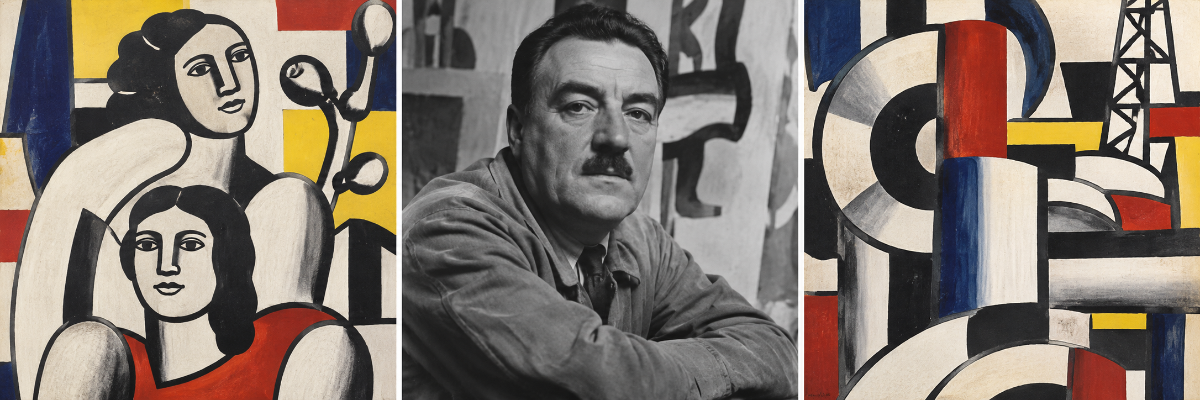
A leading figure of the twentieth-century avant-garde, Fernand Léger (1881–1955) occupies a distinctive place in the history of modern art. Associated with the early developments of Cubism, he gradually established a highly individual visual language, characterised by powerful forms, striking colour contrasts and an enduring fascination with the modern world.
Born in Argentan, Normandy, Léger moved to Paris in the early twentieth century. Fascinated by industrial modernity, architecture and the transformations of contemporary society, he developed a pictorial language in which geometric volumes, everyday objects and human figures became part of a unified visual composition. His work, instantly recognisable for its bold outlines and vibrant colours, reflects a constant desire to renew our perception of reality.
Following the Second World War, his artistic investigations increasingly took on a monumental dimension. Convinced that art should not remain confined to museums and private collections, Léger pursued numerous collaborations with architects, exploring mosaics, stained glass and ceramics. He sought to integrate painting into public spaces, making colour an essential component of architecture itself.
This ambition found one of its most remarkable expressions in his projects for the University City of Caracas, Venezuela.
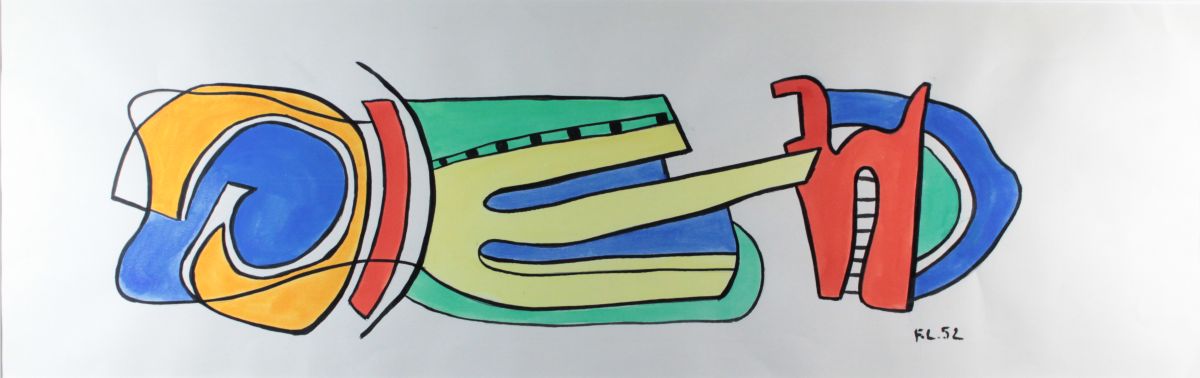
A Mosaic Design for the University City of Caracas, 1952
In 1952, Fernand Léger became involved in one of the major architectural undertakings of the post-war period: the University City of Caracas (Ciudad Universitaria de Caracas), designed by the Venezuelan architect Carlos Raúl Villanueva (1900–1975).
Conceived as a synthesis of architecture and the visual arts, this monumental complex brought together several internationally renowned modern artists, including Alexander Calder, Jean Arp, Victor Vasarely and Fernand Léger. Murals, mosaics, stained-glass windows and sculptures contributed to a new understanding of architectural space, in which works of art were no longer merely decorative elements but integral parts of the buildings themselves.
It was within this context that Léger produced a series of studies intended for monumental mosaics.
The gouache on paper presented by Saint Paul Auction, entitled Projet pour la mosaïque, Cité universitaire de Caracas(Design for a Mosaic, University City of Caracas), dated 1952, illustrates the artist's exploration of the relationship between pictorial composition and architectural space.
With its particularly elongated format (36 × 101 cm), the work reflects Léger's monumental approach to painting.
The gouache technique enabled the artist to explore the relationships between forms and colours while anticipating their translation into an architectural setting.
This composition belongs to the mature phase of Léger's career, when his artistic practice increasingly extended beyond the traditional boundaries of easel painting to engage directly with the everyday environment.
The Caracas project thus embodies one of Fernand Léger's central ambitions: to bring modern art into collective life by combining the expressive power of colour with architectural form.
|
A Work Connected to Léger's Major Monumental Projects
Fernand Léger's participation in the University City of Caracas formed part of a particularly productive period in his career.Throughout the 1950s, the artist developed several projects bringing painting and architecture together, notably the decorative programme for the Church of Notre-Dame-de-Toute-Grâce on the Plateau d'Assy, his designs for the Saint-Lô Memorial Hospital, and his compositions intended for Caracas.
The Musée national Fernand Léger in Biot preserves several examples of this monumental activity, including a design for a stained-glass window for the library of the University of Caracas. The museum's archives record that Léger submitted twelve designs to Carlos Raúl Villanueva for two mosaics, demonstrating the importance he attached to the preparatory stages of his compositions.
The work presented by Saint Paul Auction bears the inscription "N° G.120-1 / Maquette Mosaïque (Caracas) 1952" on the reverse.
It was formerly in the Simone Boquier Collection before appearing at auction in Paris on 26 September 2025, subsequently entering a private collection in the Alpes-Maritimes.
This gouache reveals an essential aspect of Fernand Léger's artistic practice: the fundamental role played by drawings and preparatory studies in the development of his monumental works.
His pursuit of an accessible, colourful art integrated into architecture also finds a particular resonance on the French Riviera, where Léger worked in Biot, now home to the national museum dedicated to his work.
The presentation of this gouache in Saint-Paul-de-Vence therefore highlights the historical connections between the artist, modern art and the Alpes-Maritimes region.
|

Documentary notes and references
1-Musée national Fernand Léger, Biot — Collections relating to monumental art in the 1950s and Maquette pour le vitrail de la bibliothèque de l'université de Caracas.2-Centre Pompidou Málaga — Carlos Raúl Villanueva, documentation concerning the synthesis of the arts and the University City of Caracas.
3-Museum of Modern Art, New York — Latin American Architecture since 1945, exhibition catalogue, 1955.
4-Comité Léger — Maquette mosaïque cité universitaire de Caracas, 1952, reference 201811-000157.
5-Artcurial — Maquette, projet de mosaïque pour l'université de Caracas, 1952, auction of 4 December 2018, lot 14