
20231002173920.jpg)

Picasso and Madoura: The Taureau Ceramic Pitcher
Pablo Picasso: Ceramics as a New Realm of Artistic Creation
In 1946, Pablo Picasso (1881–1973), then living on the French Riviera, discovered the work of the Madoura pottery workshop during an exhibition of ceramics in Vallauris. His encounter with Suzanne and Georges Ramié marked the beginning of an artistic collaboration that would continue for nearly twenty-five years, giving rise to one of the most significant bodies of ceramic work in twentieth-century art.
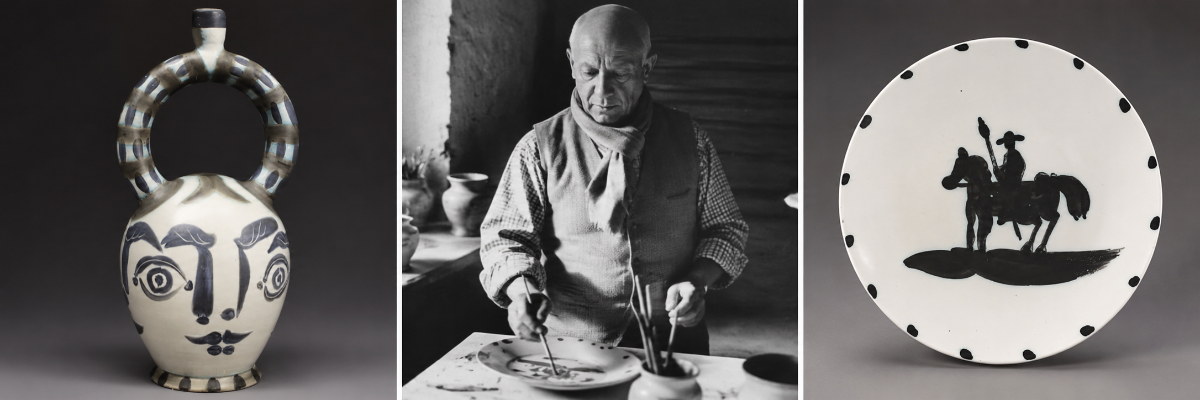
Returning to the workshop in 1947, Picasso became fascinated by the creative possibilities of clay. He experimented with modelling, engobes, engraving and glazes, exploring a visual language in which painting, drawing and sculpture converged. Plates, vases, pitchers and sculptural forms became vehicles for renewed artistic expression, inspired by the traditional craftsmanship of the Mediterranean.
Ceramics came to occupy an essential place in his artistic practice. Picasso revisited themes that had appeared throughout his career: female faces, birds, mythological figures and, above all, the bull, a recurring symbol in his artistic universe.
Far from regarding ceramics as a secondary art form, he transformed the medium into a field of artistic experimentation, turning everyday objects into works of striking and often unexpected sculptural expression.
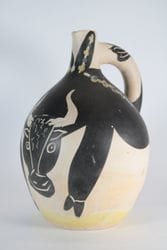
Taureau, 1955: When a Pitcher Becomes a Sculpture
Based on a model conceived on 29 March 1955, the Taureau pitcher presented by Saint Paul Auction illustrates the freedom with which Picasso reinvented traditional ceramic forms.
Executed in white earthenware, decorated with engobes and incised with a knife, the work combines the simplicity of a functional object with the expressive power of animal imagery. The rounded body of the pitcher evokes the muscular form of a bull, while its handle, neck and decoration contribute to the creation of a distinctly sculptural figure.
The bull holds a fundamental place in Picasso's iconography. Appearing in his earliest works, it became one of his most personal motifs over the decades, associated with bullfighting, Mediterranean mythology and the exploration of strength, movement and representation.
With this pitcher, Picasso goes beyond decorating an existing form: he establishes a dialogue between the object's function and its artistic identity. The ceramic becomes, simultaneously, a vessel, an image and a sculpture.
Produced in a limited edition of 100 by the Madoura workshop, the model is listed as number 255 in Alain Ramié's catalogue raisonné, Picasso, Catalogue de l'œuvre céramique édité 1947–1971, published in 1988.
The example presented by Saint Paul Auction bears the impressed stamps "Madoura plein feu" and "Edition Picasso", together with the incised inscription "Edition Picasso 71/100 Madoura".
|
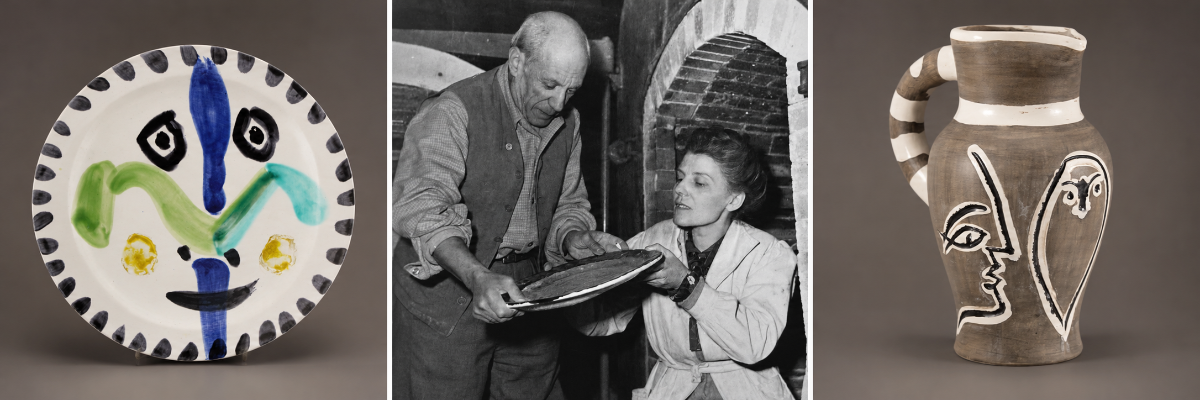
The collaboration between Picasso and the Madoura workshop represents a remarkable chapter in the history of modern art. Founded by Suzanne and Georges Ramié, the Vallauris workshop provided the artist with the technical expertise and craftsmanship that enabled him to pursue his creative investigations with exceptional freedom.
Suzanne Ramié played a decisive role in this artistic adventure. An accomplished ceramicist, she guided Picasso in his exploration of materials and production techniques, while Georges Ramié contributed to the technical organisation and distribution of the workshop's creations.
Alongside his unique ceramic works, Picasso agreed to have certain creations produced in limited editions. This approach reflected a particular ambition: to make his art accessible to a wider audience while preserving the authenticity of his artistic vision.
In the preface to his catalogue raisonné, Alain Ramié distinguishes two principal methods used in the production of these editions. The first involved faithfully reproducing an original work, both in its form and decoration. The second consisted of transferring an engraved design from a hardened plaster matrix, allowing the motif to be impressed into a sheet of fresh clay.
These techniques illustrate the close relationship between Picasso's artistic invention and Madoura's exceptional craftsmanship. The editions bear workshop marks and edition numbers, which remain essential elements in their identification, documentation and study today.
Alain Ramié's catalogue raisonné records 633 ceramic models produced in editions between 1947 and 1971, and remains a fundamental reference for the study, identification and authentication of Picasso ceramics.
Through this remarkable body of work, Picasso made a profound contribution to the revival of pottery in Vallauris, bringing the town's ceramic tradition international recognition. His ceramic creations, inseparable from his years in the South of France, demonstrate his extraordinary ability to reinvent traditional techniques and transcend the boundaries between artistic disciplines.
The presentation of the Taureau pitcher in Saint-Paul-de-Vence thus forms part of an artistic history deeply rooted in the French Riviera, where Picasso developed a major part of his post-war oeuvre.
Documentary References:
-Alain Ramié, Picasso, Catalogue de l'œuvre céramique édité 1947–1971, Éditions Madoura, 1988, no. 255, p. 135. The principal catalogue raisonné of Picasso's ceramic editions.
-Musée des Beaux-Arts de Lyon — Documentation accompanying the exhibition Picasso / Poussin / Bacchanales, concerning the collaboration between Picasso and Suzanne Ramié.
-Madoura — Historical documentation on the workshop and Picasso's ceramic editions, Picasso Ceramic Editions.
-Christie's — Catalogue entry for Picasso's Taureau model, conceived on 29 March 1955, including an analysis of its sculptural design.
-City of Vallauris — Historical documentation on Picasso and the Madoura workshop.